

| March 27, 2026
There’s a complaint you hear more and more as teams start experimenting with AI:
“ChatGPT just lies.”
It sounds dramatic, but I understand why people say it.
They run the same task twice and get different answers.
They see something that looks confident but is completely wrong.
They watch it ignore details that clearly matter.
So the conclusion becomes:
This isn’t reliable.
They’re right.
But not for the reason they think.
The Problem Isn’t That AI Lies
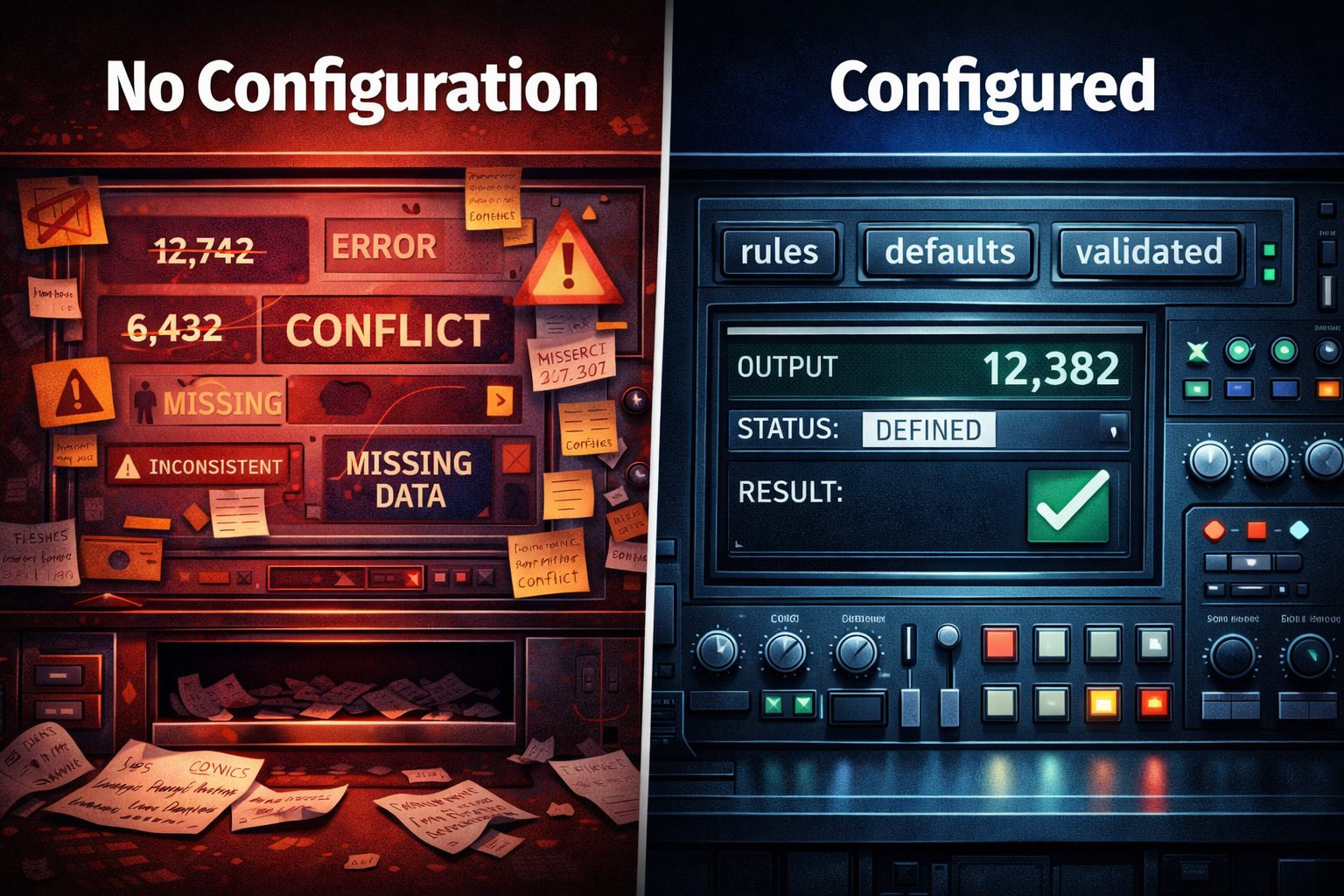
The problem is that AI fills in gaps.
Large language models are designed to produce an answer, even when the system has not been given everything it needs to produce a correct one.
If your inputs are vague, incomplete, or unstructured, the system does not stop and say:
“I don’t have enough information to do this correctly.”
It moves forward anyway.
It uses patterns.
It uses probabilities.
It makes its best guess.
That is what people experience as “lying.”
But it is not deception.
It is undefined context.
Why This Breaks Down in Real Operations
In casual use, this behavior is fine.
If you are asking for a summary or brainstorming ideas, a “pretty good” answer works.
But in operations such as quoting, onboarding, compliance, and multi-location execution, “pretty good” is not acceptable.
You need:
- the right numbers
- the right rules applied
- the right conditions respected
- the same outcome every time
Without that, the system becomes a liability.
This is where the gap between demo and reality shows up.
Where the Nuance Actually Comes From
There is a belief that if the model is advanced enough, it will pick up on nuance.
It will not do this in a reliable way.
Nuance does not come from the model magically understanding your business.
It comes from:
- clearly defined rules
- structured inputs
- explicit constraints
- intentional defaults
- systems that enforce all of the above
Nuance is built. It is not inferred.
Why “Just Plug It In” Fails
A common approach is to layer AI on top of an existing system and expect it to work.
No real configuration. No structured rules. Just give the AI access to data and let it figure things out.
This works in demos.
It fails in reality.
Real operations are not generic.
They include:
- differences between locations
- rules for when something should or should not appear
- conditional logic based on context
- internal standards that are not documented
Without configuration, none of that exists in the system.
So the AI improvises.
Improvisation is the opposite of operational reliability.
Configuration Is What Turns Guessing Into Behavior
If you want AI to stop “lying,” you do not start by changing the model.
You start by defining the system.
That means answering questions like:
- What should happen by default?
- When should something be included or excluded?
- What inputs are required before a decision can be made?
- What rules override others?
- What is the system not allowed to do?
This is configuration.
This is where the real work lives.
The Shift Most Teams Have Not Made
Most AI conversations are still focused on how smart the model is.
That is the wrong focus.
The real question is:
How controlled is the system?
A highly intelligent system without constraints is unpredictable.
An unpredictable system does not get used.
Final Thought
AI does not fail because it is not powerful enough.
It fails because it is deployed without enough definition.
If you do not give it structure, rules, boundaries, and context that reflect how your business actually operates, it will produce inconsistent results.
That is what people interpret as lying.
The difference between an unreliable AI system and a dependable one is not intelligence.
It is how well it is configured.